Tour Guide
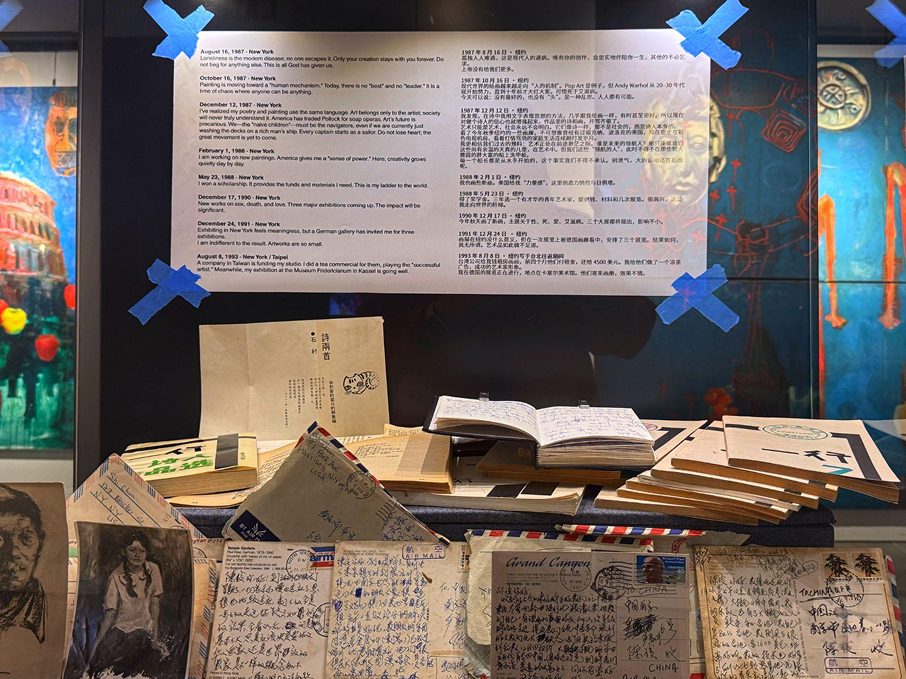
Textual Period Archive Display
Size:
Material:
This display presents letters and poetic materials by Stone Chun Shi from 1987 to 1993, documenting a phase in which artistic expression was carried out through writing prior to the formation of a visual language. Stone’s poetry was formally published as a poetry collection and belongs to a pre-visual stage: a moment when image had not yet unfolded, yet artistic structure had already been established through language.
Selected Early Letters (1987–1993)
Timeless consciousness was not a theory named later, but a way of living and practicing that had already begun in Stone’s youth—one that had yet to be recognized by the world.
In 1987, shortly after arriving in New York, Stone repeatedly wrote about loneliness and creation in his letters. For him, loneliness was not a personal predicament but a shared condition of modern life; only creation, he believed, would faithfully accompany a person throughout a lifetime, while nothing else need be sought. He early perceived contemporary art as moving toward the “mechanization of the human,” and astutely identified the era as one with “no best, no center”—a time in which outcomes were perpetually deferred.
That same year, he began placing poetry alongside painting, discovering that both employed the same inner method for expressing thought. Art, in his view, did not serve a social function; like poetry, it belonged solely to the creator. Confronted with the entertainment-driven reality of the New York art scene, he became even more convinced that art was entering a period of uncertainty, and that its true momentum might come from those still unrecognized—those who retained naivety and residual warmth.
After receiving a scholarship in 1988, which he described as a “stairway toward the world,” he did not alter his fundamental attitude toward art. In the years that followed, he continued to create works addressing themes of sex, death, love, and AIDS—not as social commentary, but as unavoidable experiences of the body and of existence. Between 1991 and 1992, his exhibitions in New York drew a limited response, yet his work was selected by aGerman gallery, leading to multiple exhibitions. Of this, he wrote in a letter: “Whatever the outcome, I don’t mind. Art objects are so insignificant.”
In 1993, while traveling between New York and Taipei, he exchanged commercial projects for creative space, while his work entered exhibition context sat the Museum of Kassel in Germany. These letters make it clear that long before timeless consciousness was named, Stone had already been living within a creative state unconcerned with results, reputation, or stages of success. Here, time is not a process but a suspended backdrop; creation itself is the only true present.
本展柜呈现石村于 1987–1993 年间的书信与诗歌文献,记录其在视觉语言形成之前,以文字完成艺术表达的阶段。石村的诗歌写作以诗集形式正式出版,它属于前视觉阶段:当图像尚未展开,文字已率先完成其艺术建构的时刻。
石村早期书信摘抄(1987–1993)
无时间意识不是后来被命名的理论,而是一种在年轻时就已经开始实践、却尚未被世界识别的生活方式。
1987 年,初到纽约的石村在书信中反复书写“孤独”与“创作”。在他看来,孤独并非个人困境,而是现代人的普遍状态;唯有创作会忠实地陪伴一生,其余不必乞求。他早早意识到,当代艺术正走向“人的机制化”,并敏锐地判断这是一个“没有最好的、也没有中心的乱世”,一切结果都被延迟。
同年,他开始将诗与绘画并置,发现二者在表达思想时采用的是同一种内在方法。艺术在他这里并不承担社会功能,而如诗一般,只属于创作者本身。面对纽约艺术生态的娱乐化现实,他反而更坚定地认为:艺术正处在前途渺茫的阶段,而真正的推动力,或许来自那些尚未被承认、仍保有天真与余温的人。
1988 年获得奖学金支持后,他将其视为“走向世界的阶梯”,却并未因此调整对艺术的基本态度。此后几年,他持续创作,主题涉及性、死亡、爱情与艾滋病,这些并非社会议题,而是身体与存在无法回避的经验。1991 至 1992 年间,他在纽约的展览反响有限,却被德国画廊看中,展开多场展览;对此,他在信中写道:“结果如何,我无所谓。艺术品如此微不足道。”
1993 年,在纽约与台北往返期间,他一方面以商业项目换取创作空间,另一方面,其作品已进入德国卡塞尔美术馆的展览体系。从这些书信中可以清楚看到:在“无时间意识”被命名之前,石村已长期生活在一种不以结果、名声或阶段性成功为坐标的创作状态之中。时间在这里不是进程,而是被悬置的背景;创作本身,即为唯一真实的当下。